
Natural refrigerants
Propane (R290) as a refrigerant: where it fits in industrial refrigeration – and what the safety concept must deliver
Refrigerant R290 in chillers, heat pumps and free cooling: properties, safety group A3, installation and system choice – explained using KSI systems.
Propane is one of the natural refrigerants gaining importance in industrial refrigeration. Under the designation R290, it works in chillers, in heat pumps and in combined cooling and heating systems. It has a very low global warming potential and good conditions for efficient operation. At the same time, propane is flammable. Whether R290 fits a given project therefore depends on the required temperatures, the cooling capacity, the installation location and the safety concept.
What distinguishes propane as a refrigerant
R290 has a global warming potential (GWP) of 0.02, based on 100 years. This is the value set by Regulation (EU) 2024/573 in Annex VI; it is based on the Sixth Assessment Report of the IPCC. Older publications often cite the value of 3 from the Fourth Assessment Report. For comparison: the scale is set up so that CO₂ carries the value 1. Synthetic refrigerants that have shaped the market for decades are several orders of magnitude higher. For a system intended to run for 15 years or more, this becomes noticeable in refill quantities, in servicing and in residual value. However, the climate footprint is not determined by the refrigerant alone. Tightness, energy consumption and the power supply of the system are also part of the assessment.
Thermodynamically, propane is a high-performance refrigerant. How efficiently a system operates with it depends on its design and operating conditions. A key factor is the temperature lift between the cold and warm side. Higher permissible chilled water temperatures reduce it and relieve the compressor. Higher required heating temperatures increase it and cost efficiency. The temperature requirements of the consumers should therefore be put on the table at the start of planning.
According to ASHRAE 34 and DIN EN 378, propane is classified in safety group A3 classified as: low toxicity, high flammability. This classification determines the framework for fill quantity, installation location and safety technology. It also determines which system architecture is suitable for a project.
An overview of CO₂, ammonia and propane with their characteristic values and fields of application is provided on our page on natural refrigerants.
Flammable means: the safety concept has to come first
In the event of a release, propane can form an ignitable mixture with air and, at high concentrations, displace oxygen. The gas is heavier than air. It collects in shafts, depressions and lower-lying areas, even if the installation room itself is well ventilated. Everything else follows from these properties.
A propane refrigeration system is planned around its safety concept. That sounds like a limitation, but in practice it is above all a matter of sequence. Anyone who clarifies the safety questions at the start gains freedom in the design. Anyone who leaves them until the end often ends up planning twice.
Fill quantity per refrigeration circuit. The permissible charge quantity depends on the installation location, on accessibility and on ventilation. The applicable standards define categories for this, which need to be checked at the start of planning for the specific project. This determines whether a cooling capacity can be realised in a single circuit or split across several circuits.
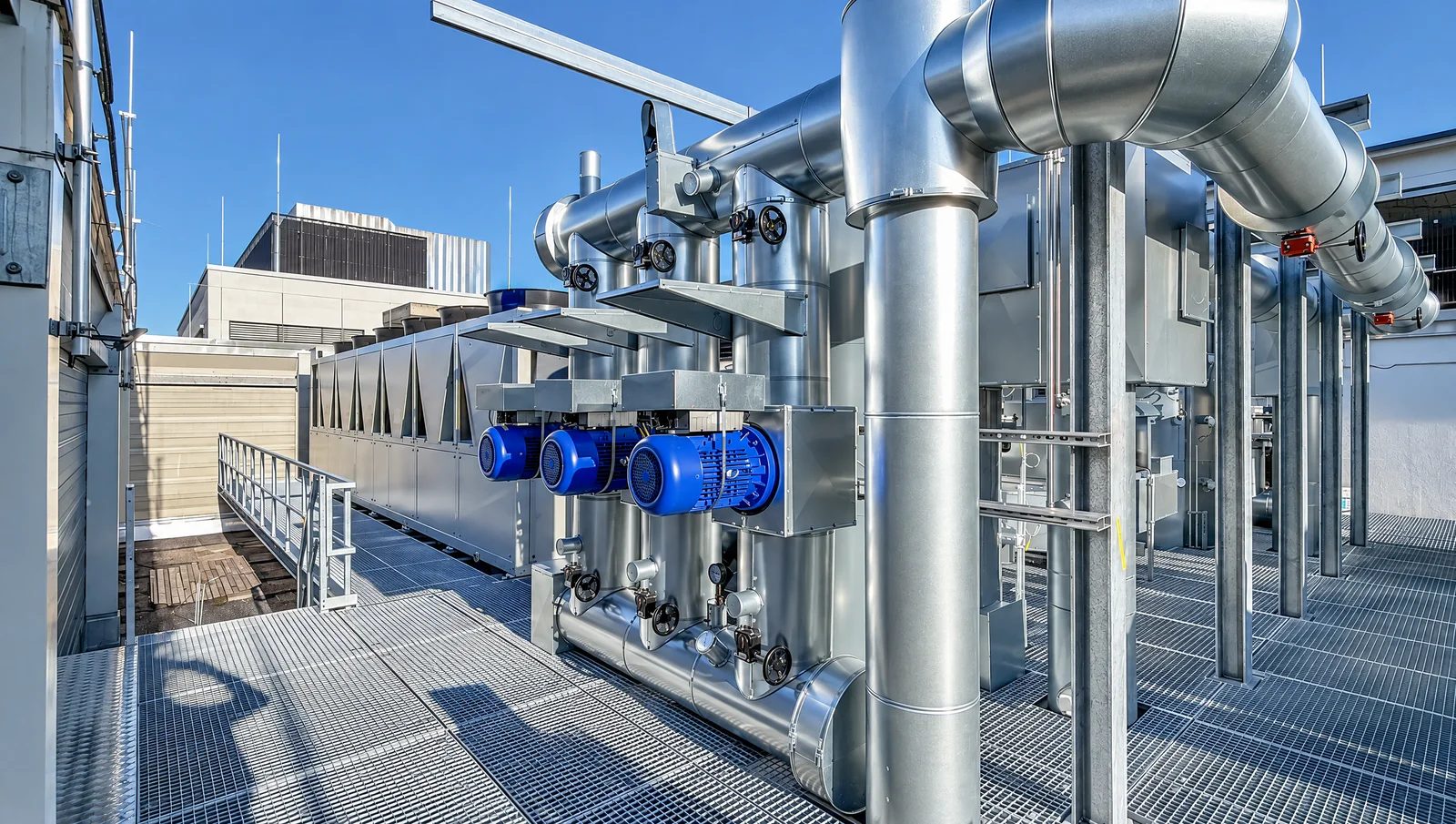
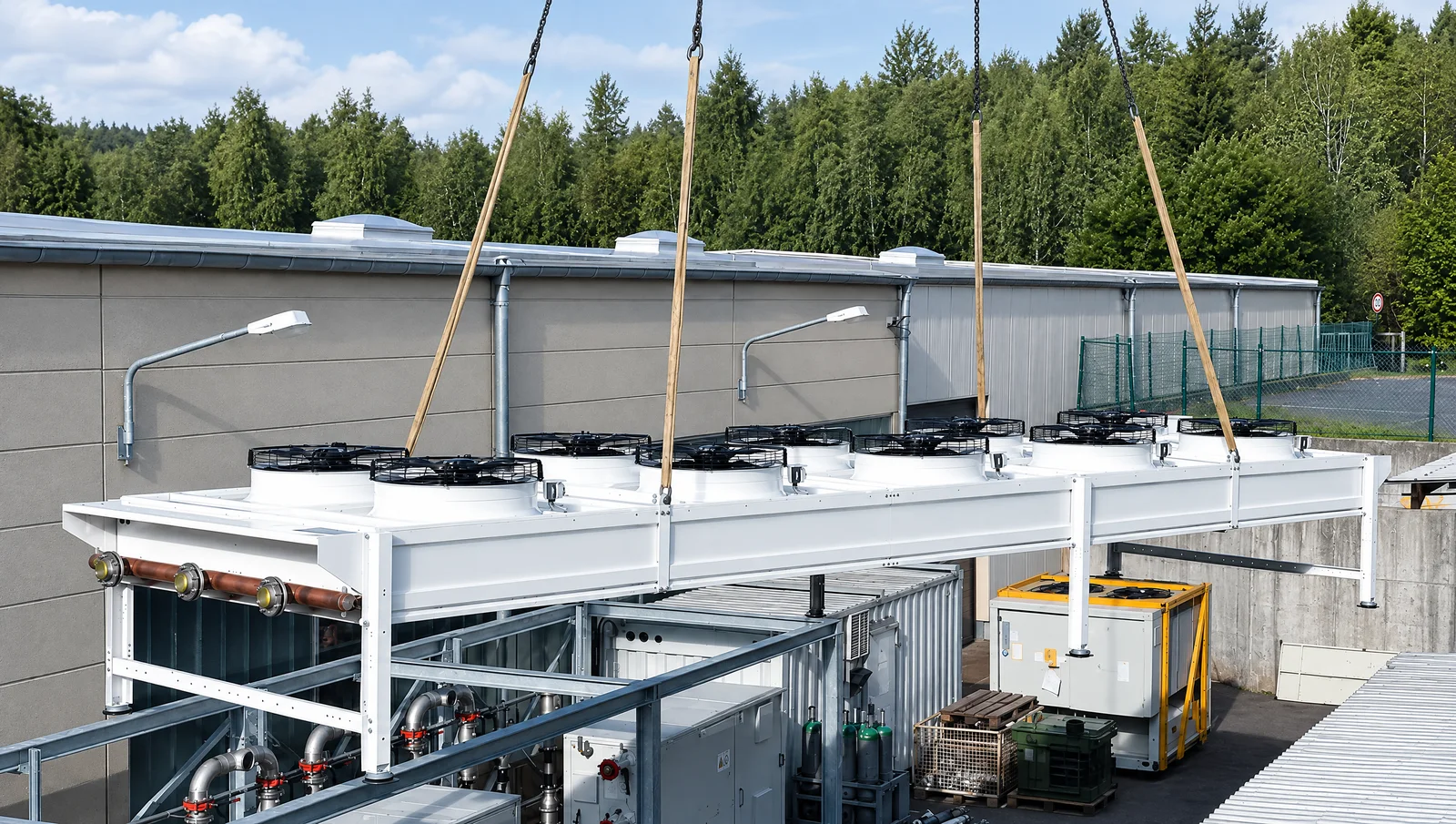
Installation. In many industrial projects, the plant room with the propane chillers is built outdoors. The refrigerant remains outside the occupied areas, and the setup can be organised in parallel with ongoing operations. However, an outdoor installation does not automatically mean that any escaping refrigerant is adequately dispersed. Shafts, building openings, recesses and the actual air movement at the site need to be checked as well as possible ignition sources in the vicinity. An indoor installation is possible, but requires a correspondingly designed plant and space concept with ventilation and gas detection.
Indirect system. With most propane systems from KSI, the refrigerant remains in the plant room. Chilled water or chilled brine flows to the consumers. No refrigerant-carrying pipework runs through production, storage or the server room. The hydraulics thus take on part of the safety concept and can also be designed redundantly. Nevertheless, it remains part of the safety assessment, for example in heat exchangers and venting.
Safety engineering. Gas detection sensors in the right places, defined shutdowns, ignition-source-free design in the installation room, and the isolatability of individual circuits are part of the system and are fixed during planning. In addition, there is maintenance, inspection and safe access to the components. Retrofitting is possible, but complex.
Where propane fits in industrial refrigeration
Typical fields of application result from these properties.
- Chillers for process cooling and building cooling. Compact chillers supplying a chilled water network are the most common application. The cooling capacity is distributed across several units, with the network handling distribution.
- heat pumps with simultaneous cooling and heating demand. Propane is suitable for systems in which the warm side is also put to use. In plastics processing, for example, production requires cooling and heat at the same time.
- Systems with a high free cooling share. Data centres and processes with a year-round base load run higher flow temperatures. Propane maintains efficiency at this temperature level, and the outdoor installation of the plant room fits the free cooling concept.
- Standard cooling in combination with CO₂ for freezing. In projects with both temperature levels, propane handles standard cooling, while CO₂ systems supply the freezing. Each refrigerant works where its strength lies.
Propane is less suitable where large cooling capacities are required in a single circuit and the fill quantity cannot be distributed across several units. In this area, ammonia has its place.
Free cooling and heat utilisation: what the control system must achieve
Free cooling is not a property of propane. It uses low outdoor temperatures to remove heat from the chilled water or chilled brine circuit, so that the compressor runs less or, at times, not at all. Pumps and fans still require electricity. How large the free cooling share is over the year depends on the location, the system temperatures, the heat exchangers and the load profile. Propane suits this mode of operation because it maintains its efficiency at the higher flow temperatures that favour free cooling.
If heat is needed at the same time, using the waste heat is usually more economical than releasing it to the surroundings. The control system must then consider cooling demand, heat demand and external conditions together and derive the operating point from this. In production facilities with simultaneous cooling and heating demand, this is where the real potential of a combined system lies.
Multiple units: part load and redundancy
With propane, splitting the cooling capacity across several circuits or units is often already dictated by the fill quantity limit. It also brings further advantages: staged capacity provision, better part-load behaviour and the possibility of servicing one unit while the others continue to run.
However, redundancy only results from the design. What matters is which capacity actually remains available if one unit fails, and whether pumps, hydraulics, control systems and power supply are equally backed up. A redundantly designed chiller is of little use if the shared distribution is built as a single string.
Refrigerant R290 and the F-Gas Regulation
Regulation (EU) 2024/573 gradually reduces the available quantities of partly fluorinated refrigerants (HFCs) and contains application-related restrictions for equipment and refrigerants. Which requirements apply to a specific project depends on the application, the time of commissioning and the version in force at the time. This needs to be checked at the start of planning.
Propane is not a fluorinated greenhouse gas and is not subject to the HFC quota scheme. A system with R290 can be operated and maintained with the same refrigerant over its entire service life, without the availability or price of the refrigerant depending on scarcity. This is already an argument at the planning stage that goes beyond investment costs. The requirements for safety, the qualification of the specialist contractor and operator obligations apply regardless and remain to be examined.
From practice: cooling and heating with propane in plastics production
For an internationally leading company in the plastics industry, KSI Kältetechnik built a central cooling and heating system for the production processes at its Zella-Mehlis site. The system operates with propane and combines the refrigerant with heat pump technology.
The key points:
- Refrigerant: R290 (propane)
- Cooling capacity: 2 × 318 kW
- Heating capacity: 2 × 403 kW
- Heat rejection capacity: 800 kW
- Redundancy: 100%, all pumps designed redundantly
- Mode of operation: Cooling, heating and free cooling operation, controlled according to current demand
- Control: Siemens central control system with visualisation and secure remote access
- Installation: Plant room outdoors, installation carried out in parallel with ongoing production
- Planning: entirely in 3D
The core of the concept lies in the simultaneous use of both sides of the heat pump. The cold side cools the processes, the warm side delivers heat to where it is needed in production. What would otherwise be released into the environment via the heat rejectors partly remains in the process. Free cooling operation supplements this during the times when the outside temperature allows cooling without a compressor. All details can be found in the Reference Uponor.
Two further systems demonstrate the range. In the data centre of the NorthC Datacenters in Munich propane chillers with 1.0 MW cooling capacity and 100% redundancy take over the central cooling, with dynamic switching between chilled and free cooling operation and integrated heat recovery. In the Maritim Hotel Amsterdam six propane chillers supply standard cooling for 30 cold stores and other cooling points via chilled brine, while CO₂ systems handle deep-freezing. The choice of refrigerant is in each case based on the requirements of the respective system.
Converting an existing system to propane
R290 can also be an option when modernising an existing refrigeration system. As a rule, this is not a simple replacement of the refrigerant in the existing circuit: compressors, heat exchangers, safety devices and installation must be suitable for propane. In practice, therefore, the focus is usually on renewing the refrigeration generation, while it is checked which parts of the existing infrastructure can continue to be used, such as the chilled water network, consumers, heat rejection units or building services.
Whether the changeover succeeds during ongoing production depends on the existing system and on a viable transition concept. At Uponor and NorthC, the new plant room was built alongside ongoing operations and only then integrated. How KSI assesses and rebuilds existing systems is described on the page Revitalisation and modernisation.
What matters when planning a propane refrigeration system
Anyone assessing an offer or a concept with R290 will get far with these questions:
- What temperatures do the consumers need, and what does this mean for the temperature lift? This is where a large proportion of operating costs is decided.
- How is the fill quantity per circuit justified, and which installation category forms the basis? The assumptions should be transparent and match the actual installation site.
- Does the refrigerant remain in the plant room? Indirect systems with chilled water or chilled brine keep the occupied areas free of the flammable substance.
- Is the redundancy continuous? Across refrigeration generators, pumps, hydraulics and controls, not just at the chiller.
- How much free cooling and heat utilisation has been calculated for the site, and on what data basis? The assumptions should be comprehensible.
- How does the system behave under partial load? Multiple units offer advantages here when the control system makes use of them.
- What safety technology is planned, and who maintains it? Gas detection and shutdowns require inspection intervals like any other component.
- Can it be maintained while in operation? Shut-off capability, accessibility and a switchover concept must be part of the planning.
How KSI Kältetechnik supports this
KSI plans, builds and maintains industrial refrigeration systems with natural refrigerants – from the energy-related planning and conceptual design via the Installation and commissioning up to the technical support with 24/7 availability.
For an R290 project, temperature requirements, load profiles, installation and supply reliability are considered together. This results in the choice of system between direct and indirect design, the distribution of cooling capacity across circuits and units, the safety concept with installation and gas warning technology, as well as the design for free cooling, heat utilisation and demand-based control.