
data centre
Cooling for data centres: what the system needs to deliver – and where efficiency is created
Data centre cooling between availability and operating costs: chilled water, free cooling, redundancy and natural refrigerants – explained with a real project.
Data centre cooling runs continuously and is at the same time one of the largest items in operating costs. How far availability and efficiency can be combined is decided early on: in the chilled water temperature, the redundancy concept, the control strategy and the question of how much cooling capacity can be handled without compressors.
How are data centres cooled?
Most data centres are cooled via a chilled water system. A central refrigeration plant made up of chillers and dry coolers supplies chilled water, computer room air handlers transfer the cooling to the room air, and separating cold and hot aisles ensures that the cool air arrives where the servers draw it in. When it is cold enough outside, free cooling takes over part or all of the work and the compressor stands still. At very high power densities, for example with AI servers, liquid cooling directly at the chip or in an immersion bath is increasingly added.
How KSI plans, builds and maintains cooling supply for data centres is described on our service page.
Why cooling in the data centre is a special case
In many industrial applications, the cooling load varies considerably – with shift operations, with batches, over the course of the day. In the data centre, the heat load is largely constant: practically all the electrical power consumed by the IT is released again as heat and must be removed. This shifts the priorities of the design.
Stability over peak performance. The maximum cooling capacity says little about how well a system performs in data centre operation. What matters more is how tightly it maintains the supply air temperature over long periods. The decisive factors here are the permissible operating conditions of the IT – temperature and humidity within the limits set by manufacturers and operators. Fluctuations within this window are generally uncritical; it becomes critical when the limits are exceeded or the control system cannot keep up with load changes.
Redundancy across the entire chain. These include chillers, pumps, hydraulics, controls and power supply. A redundantly designed chiller is of little use if the distribution system is built as a single string.
Maintainability during ongoing operation. A data centre cannot be shut down for a pump replacement. Isolatability, accessibility and a viable switchover concept must therefore already be included in the planning.
Server room or data centre: two different tasks
"Server room cooling" and "data centre cooling" are often used synonymously. Technically they are two different classes.
A Server room in the company typically lies in the single-digit to low double-digit kilowatt range. Direct expansion split units or compact chillers are usually used there; redundancy is achieved via a second, independent unit.
A data centre begins where power density, redundancy requirements and continuous operation justify a dedicated refrigeration system: central refrigeration generation, chilled water network, defined load zones, higher-level control. From this size onwards, planning is about the plant structure and no longer about the choice of unit. That is also where the differences in energy consumption lie.
Consider refrigeration generation and air conditioning separately
In tenders, "data centre air conditioning" and "data centre cooling" often appear in one breath. For planning purposes, the distinction is worthwhile:
- The Refrigeration generation provides chilled water – chiller, heat rejection unit, pumps, hydraulics.
- The Air conditioning brings this cooling to the hardware – recirculation cooling units, air routing, cold/hot aisle separation, volume flows.
Both sides need to be matched to each other. An efficient refrigeration generation loses its advantage if the air routing mixes cold and warm air, because the return temperature no longer matches the design. In the existing-system assessment, this interface is, from experience, the most productive point: it can often be improved without intervening in the refrigeration generation.
Free cooling and the chilled water temperature
The greatest influence on operating costs is exerted by the free cooling – the mode in which the outside air removes the heat and the compressor is fully or partially at a standstill.
A key control variable is the chilled water temperature. Higher flow temperatures generally increase the usable potential for free cooling. However, how many hours of free cooling are actually achieved per year depends on the overall system – on the design of the heat rejection units, on the hydraulics, on the control system and on the climatic conditions at the site. An unnecessarily low chilled water temperature limits this potential over the entire service life of the system and can later only be corrected with considerable effort.
Equally important is the transition between operating modes. A control system that only switches between free cooling and compressor operation leaves the mixed range unused. A more sensible approach is a smooth transition that adapts both operating modes to the current IT load.
the heat rejected can be used via a heat recovery continue using, rather than releasing it entirely to the environment. However, this requires a consumer and a temperature level that matches its requirements – both need to be considered early in the design.
Liquid cooling and AI servers: what changes
With AI applications, the power per rack rises significantly. Beyond a certain density, air is no longer sufficient as a heat transfer medium, because the required air volumes can hardly be moved through the rack. Operators are therefore increasingly turning to liquid cooling, in two basic forms:
- Direct liquid cooling (direct-to-chip): Cold plates sit directly on processors and graphics chips, and a water or glycol circuit absorbs the heat where it arises.
- Immersion cooling: The servers are fully submerged in an electrically non-conductive liquid that transfers its heat to a water circuit via a heat exchanger.
This does not make central refrigeration redundant; it changes its role. Liquid circuits generally operate at significantly higher supply temperatures than conventional chilled water. This allows free cooling to cover a large part of the year, and the waste heat is at a temperature level suitable for heat recovery. In most data centres, part of the load nevertheless remains air-cooled, such as network equipment, storage and power supply. The plant then has to serve two temperature levels in parallel.
Anyone building or expanding today should plan for this in the basic structure: connections for a second, higher-temperature circuit, reserve capacity in the hydraulics and a control system that manages both circuits together. Retrofitting this later is considerably more complex.
Natural refrigerants in the data centre
The European F-Gas Regulation is gradually restricting synthetic refrigerants with a high global warming potential (GWP). For a refrigeration system intended to run for 15 years or longer, this affects the economic viability over its service life: in terms of top-up quantities, availability in the event of servicing, and the residual value of the system.
Propane (R290) has established itself in this environment. It has a GWP of 0.02, good thermodynamic properties and achieves high efficiencies even at the higher flow temperatures required for free cooling and heat recovery. Propane is flammable and classified in safety group A3; limited fill quantities and a suitable safety concept are therefore essential. In practice, this is often solved by installing the plant room outdoors.
An overview of CO₂, ammonia and propane with their characteristic values and areas of application can be found on our page on natural refrigerants.
What the Energy Efficiency Act means for refrigeration technology
For data centres in Germany, this poses Energy Efficiency Act (EnEfG) requirements for energy efficiency. This is based on the PUE (Power Usage Effectiveness), i.e. the ratio of total energy demand to the energy demand of the IT. In addition, there are requirements for the use of waste heat.
Which values, deadlines and verification obligations apply in a specific case depends, among other things, on the connected load, the time of commissioning and the version of the legal requirements applicable at the time. For a specific project, this needs to be checked at the start of planning, because it gives rise to requirements for measurement technology and system design.
For refrigeration technology, this has several consequences, regardless of the individual limit value. The share of cooling in total electricity consumption becomes a figure that must be documented – this requires meters, sensors and a measurement concept that are planned in from the start. Chilled water temperature and the free cooling concept largely determine which values a site can achieve at all, and are fixed during design. And heat recovery moves beyond a purely economic consideration.
From practice: NorthC Datacenters, Munich
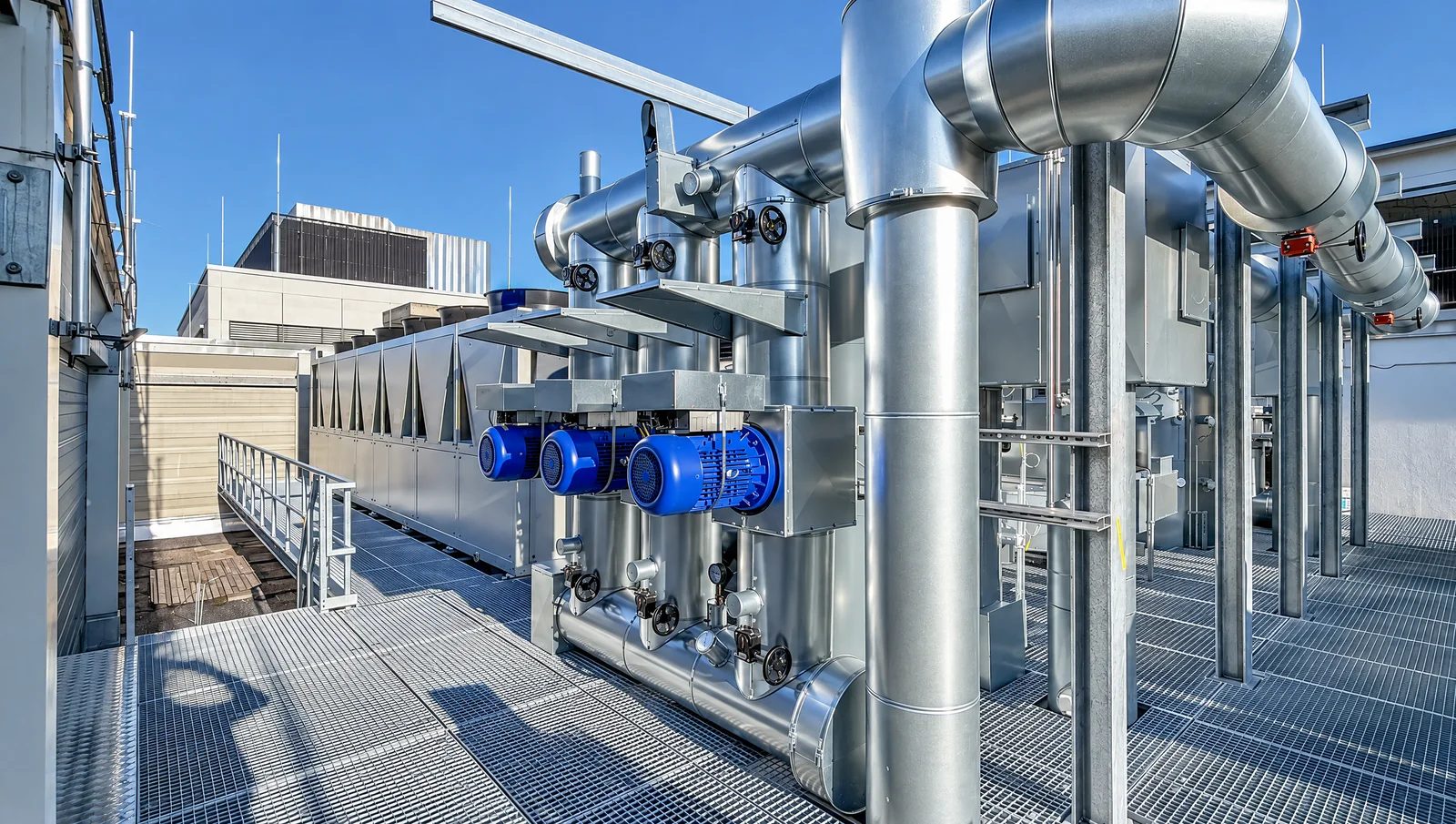
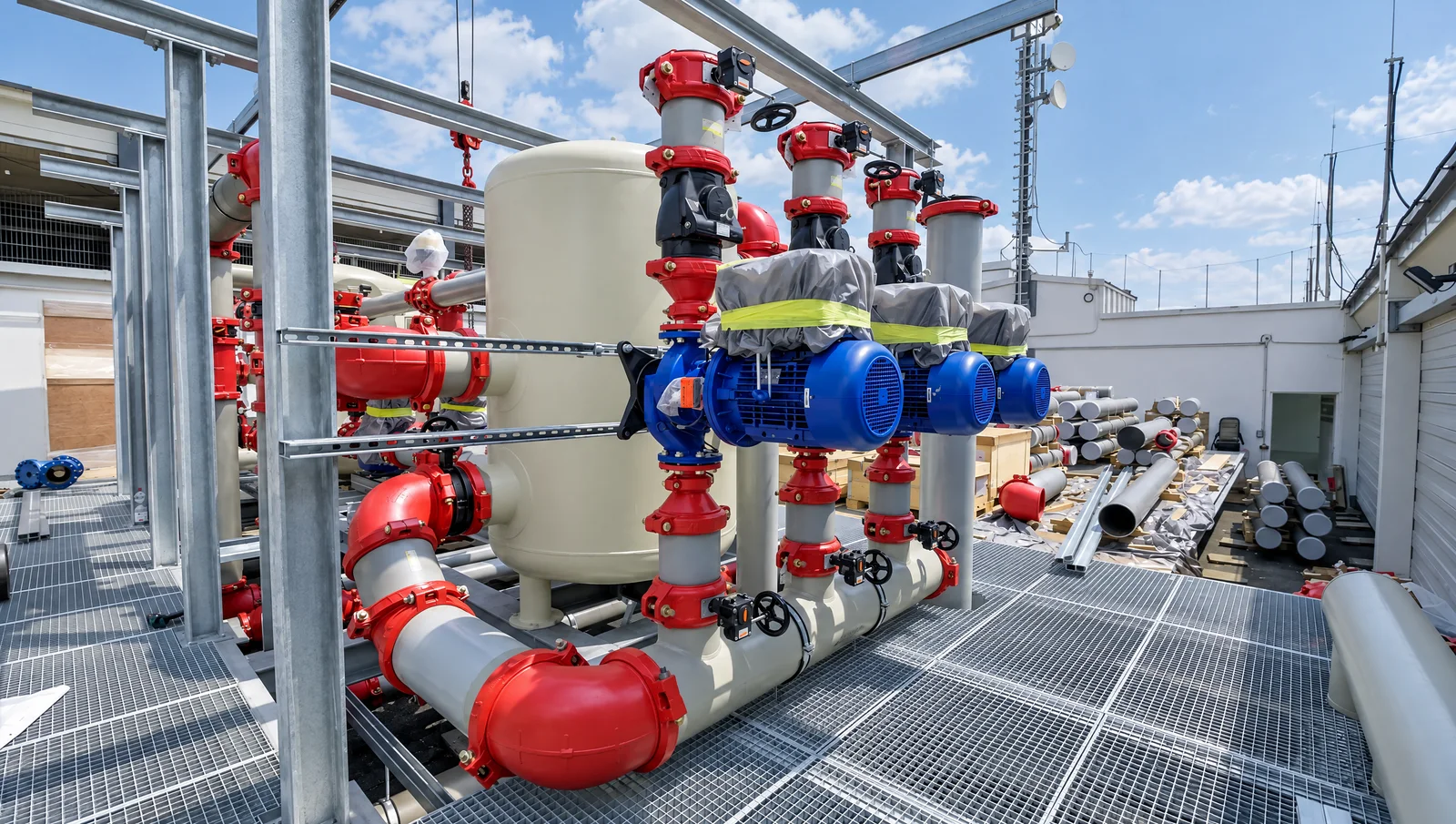
For the NorthC Datacenters GmbH KSI Kältetechnik has implemented the first expansion stage of the central cooling system at the Munich site – as a energy-related refurbishment during ongoing data centre operation, without interrupting the existing IT infrastructure.
The key points:
- Refrigerant: R290 (propane)
- Cooling capacity: 1.0 MW
- Redundancy: 100%, all pumps designed redundantly
- Mode of operation: dynamic switching between cooling and free-cooling operation, controlled according to current IT load
- heat recovery integrated into the chiller plant
- Control: Siemens central control system with visualisation and secure remote access
- Design: Plant room built entirely outdoors, in parallel with ongoing operation
- Planning: entirely in 3D, due to the limited roof area
Two aspects shaped the execution. The plant room was built entirely outdoors and in parallel with ongoing operations, so that the data centre kept running throughout the construction period. And, given the limited roof area, complete 3D planning was essential to safely coordinate all components with one another.
The system is designed so that further expansion stages can be connected without intervening in the basic structure. All details on the project can be found in the Reference NorthC Datacenters.
What identifies a reliable design
Anyone assessing a refrigeration concept for a data centre – whether new build or refurbishment – will get far with these questions:
- What chilled water temperature is assumed, and how is it justified? Higher flow temperatures increase the potential for free cooling, but require appropriate design on the air side.
- How many free cooling hours are calculated for the site, and on what data basis? The assumptions should be transparent.
- Is the redundancy continuous? Across generators, pumps, hydraulics and controls.
- Can it be maintained while in operation? Shut-off capability, accessibility, switchover concept.
- How does the system behave under partial load? data centres rarely run at the design point
- Will the refrigerant last over the planned service life of the system?
- What measurement technology is planned? Without a meter on the refrigeration side, it is later impossible either to optimise or to prove anything.
Where these questions can be answered reliably, the design is usually also sound in terms of energy. If they remain unanswered, experience shows this only becomes apparent during operation – and corrections are then costly.
Frequently asked questions about data centre cooling
Who builds the cooling for a data centre?
The refrigeration plant with chillers, dry coolers, pumps, hydraulics and controls is built by a refrigeration contractor, usually together with the building services engineers and the manufacturers of the computer room air handlers. What matters is that one party is responsible for the overall system. KSI Kältetechnik plans and builds the cooling supply for data centres from a single source, from concept to maintenance.
How much cooling capacity does a data centre need?
The starting point is the electrical power of the IT, because almost all of it becomes heat. Added to this are other heat sources such as the power supply, as well as reserves for redundancy and future expansion stages. A data centre with 1 MW of IT load therefore needs at least around 1 MW of cooling capacity, plus the redundant design.
Can the cooling be renewed during ongoing operation?
Yes, if the transition concept is defined at the outset. The usual approach is to build the new plant room alongside the existing one and only switch over afterwards. This is how KSI refurbished the central cooling at NorthC Datacenters in Munich without shutting down the IT.
How KSI Kältetechnik supports this
KSI plans, builds and maintains industrial refrigeration systems with natural refrigerants – from the energy-related planning and conceptual design via the Revitalisation of existing systems up to the technical support with 24/7 availability.
What this means specifically for data centres is set out in full on our page Refrigeration technology for data centres.
For data centres, this includes load zone analysis and efficiency assessment of existing systems, the design of chilled water and free cooling concepts, refurbishment during ongoing operation, and the continuous monitoring of operating conditions. An overview of the sector's requirements can be found on our page Sectors: data centre.